CVE and CVSS Explained: How Vulnerabilities Are Scored
CVSS explained with the formula, a calculator tested on 1,626 real scores and data from 1,760 exploited flaws.
- 38 min read
- 39 sections
- Published November 24, 2026
CVE and CVSS are two different things that people constantly mix up. A CVE is an identifier, a public name for one specific security flaw.
CVSS is a scoring system that rates how severe a flaw is, on a scale from 0 to 10.
Most explanations stop at that one-line difference. This guide goes further.
I wrote a CVSS 3.1 calculator from the official formula, which you can run with your own vector.
I tested it against 1,626 real published scores, and analyzed the CVSS scores of all 1,760 vulnerabilities in CISA’s Known Exploited Vulnerabilities catalog.
I also pulled exploit-prediction scores for each one, so you can see where severity and real-world risk part ways.
The data comes from three sources: CISA’s catalog as of October 27, 2026, the published CVE records read on November 19, 2026, and FIRST’s EPSS scores dated November 18, 2026.
The prioritization scenario is invented. A script at the end reproduces every figure I calculated, and the data files are published with it.
The short answer
A CVE number, such as CVE-2021-44228, names a flaw so that everyone can talk about the same one. A CVSS score tells you how bad the flaw could be in general terms.
Neither tells you how likely it is that someone will attack you tomorrow.
For deciding what to fix first, use the CVSS score as one input. Add whether the flaw is known to be exploited, how likely exploitation is, whether the affected system is exposed and what an attacker would gain.
In my data, 202 of the 1,681 exploited flaws with a version 3 score, or 12.0 percent, had only a Medium rating, so a severity score alone would have pushed some of them down the queue.
Good to know: Scores and catalogs change daily. The figures here are a snapshot, and the models are illustrations.
What a CVE is
CVE stands for Common Vulnerabilities and Exposures. Each CVE has an identifier in the form CVE, a year and a number. The identifier is a label for one publicly disclosed flaw, together with a short description and references.
The label is useful because the same flaw can be described under many names in different products, advisories and news stories. A shared identifier lets a scanner, a vendor bulletin and your ticket all point at the same thing.
Who creates the records
CVE records are published by organizations called CNAs, which are authorized to assign identifiers within their scope.
Five parties are easy to confuse.
| Party | What it does |
|---|---|
| CVE Program | Runs the identifier system and the record format |
| CNA, a CVE Numbering Authority | Assigns identifiers in its scope and writes the record. Often the vendor itself |
| ADP, an Authorized Data Publisher | Adds data to a record after publication, in its own container |
| CISA | Acts as an ADP that adds scores and weakness types, and separately runs the exploited catalog |
| NVD, the National Vulnerability Database | A US government database that analyzes CVE records and adds its own scores |
In the records I downloaded, each had a container written by its CNA. Many had extra containers added by an ADP, most often CISA’s. This guide reads the CVE records directly and does not use NVD’s scores.
The identifier’s year is not always the year the flaw was found or first exploited. It reflects when the identifier was assigned or reserved.
I return to this point later, because it matters when you read the age of a vulnerability.
What a CVE does not tell you
A CVE entry says that a flaw exists and describes it. It does not tell you whether it is exploitable in your environment, whether a fix exists or how urgent it is.
Severity and urgency come from other systems, and CVSS is the best known.
What CVSS is
CVSS stands for the Common Vulnerability Scoring System. It is maintained by FIRST, the Forum of Incident Response and Security Teams.
Its own specification calls it an open framework that communicates what a software flaw is like and how severe it is.
A CVSS score is a number from 0.0 to 10.0 calculated from a set of metrics.
The metrics are written in a compact text form called a vector string, so the same score can be reproduced by anyone with the same inputs.
The qualitative ratings
The scores map to named ratings. The CVSS version 4.0 specification lists the scale, and version 3.1 uses the same bands.
| Rating | Score range |
|---|---|
| None | 0.0 |
| Low | 0.1 to 3.9 |
| Medium | 4.0 to 6.9 |
| High | 7.0 to 8.9 |
| Critical | 9.0 to 10.0 |
The specification adds that using the named ratings is optional. They exist to help organizations assess and prioritize, and they are not a requirement for publishing a score.
CVSS versions
Several versions are in circulation. In my data of exploited vulnerabilities, most scores came from version 3.1, with some from 3.0 and a smaller group from 4.0.
| Version | Notes |
|---|---|
| 2.0 | The older system, still present in some records |
| 3.0 and 3.1 | The widely used versions, with a base score from eight metrics |
| 4.0 | The newest version, which adds Attack Requirements and groups metrics as Base, Threat, Environmental and Supplemental |
Version 4.0 also asks scorers to label the score by the metrics used. Its nomenclature includes CVSS-B for base metrics only, CVSS-BE for base and environmental, CVSS-BT for base and threat and CVSS-BTE for all three.
The specification says the usefulness of a score is directly proportional to the metrics that produced it.
Base, temporal and environmental: three different scores
CVSS is not one number. Each version defines groups of metrics, and only the first group describes the flaw alone.
| Version 3.1 group | What it describes | Who usually supplies it |
|---|---|---|
| Base | Traits of the flaw that stay constant over time and across environments | The vendor or another scorer |
| Temporal | Traits that change over time, such as exploit availability and patch status | Analysts or vendors |
| Environmental | Traits of one organization’s environment, such as controls and asset importance | The organization using the software |
Version 4.0 keeps the idea and changes the names.
| Version 4.0 group | What it holds | Changes the score? |
|---|---|---|
| Base | Exploitability and impact, with impact split between the vulnerable system and subsequent systems | Yes |
| Threat | One metric, Exploit Maturity | Yes |
| Environmental | Security requirements and modified base metrics set by the consumer | Yes |
| Supplemental | Extra context such as Safety, Automatable and Recovery | No |
Almost every published score is a base score. It describes the flaw in general. It is not an assessment of risk in your environment, because nobody outside your organization can fill in the environmental group.
The two specifications are the authority here: CVSS 3.1 and CVSS 4.0.
The metrics behind a CVSS 3.1 base score
The base score depends on eight metrics. Four describe how the attack is carried out, one describes scope and three describe impact.
| Metric | Values | Meaning |
|---|---|---|
| Attack Vector (AV) | Network, Adjacent, Local, Physical | How close the attacker must be |
| Attack Complexity (AC) | Low, High | Conditions beyond the attacker’s control |
| Privileges Required (PR) | None, Low, High | Access needed before the attack. Its weights depend on Scope |
| User Interaction (UI) | None, Required | Whether another person must act |
| Scope (S) | Unchanged, Changed | Whether the impact reaches resources managed by a different security authority |
| Confidentiality (C) | High, Low, None | Effect on data secrecy |
| Integrity (I) | High, Low, None | Effect on data trustworthiness |
| Availability (A) | High, Low, None | Effect on service availability |
A vector string for the most common critical case looks like this: CVSS:3.1/AV:N/AC:L/PR:N/UI:N/S:U/C:H/I:H/A:H. It reads as a network attack, low complexity, no privileges, no user interaction, unchanged scope and high impact on all three.
How the score is calculated
The formula combines an impact sub-score and an exploitability sub-score. Each metric value has a fixed weight from the specification. I implemented the version 3.1 formula directly.
Step 1: The impact sub-score
Start with the impact sub-score base, which is 1 minus the product of 1 minus each impact weight for confidentiality, integrity and availability. For high impact on all three, the weights are 0.56 each, which gives 0.915.
If scope is unchanged, the impact is 6.42 times that figure, or 5.87. If scope is changed, a different expression applies, which raises the weight of changes that cross a boundary.
Step 2: The exploitability sub-score
Multiply 8.22 by the weights for attack vector, attack complexity, privileges required and user interaction. For a network attack with low complexity, no privileges and no interaction, the weights are 0.85, 0.77, 0.85 and 0.85, which gives 3.89.
Step 3: Combine and round up
Add the two sub-scores and, if scope changed, multiply by 1.08. Cap the result at 10, and round up to one decimal place. For the common case above, the sum is 9.76, which rounds up to 9.8.
With scope changed, the same inputs give 10.0.
My calculator returned 9.8 and 10.0 for those two vectors, which are the published scores for the common critical case and for Log4Shell.
Testing the calculator against real scores
A formula is easy to get wrong, so I tested mine. For all 1,760 exploited vulnerabilities, I downloaded the CVE record and extracted every version 3.1 vector string with its published base score. That gave 1,626 vector and score pairs.
| Result | Count |
|---|---|
| Vectors tested | 1,626 |
| Calculator matched the published score | 1,604 |
| Did not match | 22 |
| Match rate | 98.6% |
Why 22 did not match
I looked at the 22 closely. Of the 1,626 vectors, 229 carried extra temporal metrics for exploit maturity, remediation level and report confidence, and 1,397 did not.
Among the 229 with temporal metrics, the published score equals the base formula for 210 and equals the temporal-adjusted formula for 18. That is an observation about the numbers.
The records do not say why, so I do not know whether those 18 were intended as temporal scores.
For one more, neither formula matched.
Among the 1,397 without temporal metrics, 1,394 matched the base formula. Three differed: two published 8.1 where the formula gives 8.0, and one published 10.0 where it gives 9.9. All three have changed scope.
So four mismatches remain unexplained.
| CVE | Published score | Formula result | Note |
|---|---|---|---|
| CVE-2024-55591 | 9.6 | 9.8 | Vector includes temporal metrics. Neither formula gives 9.6 |
| CVE-2025-23209 | 8.1 | 8.0 | Changed scope |
| CVE-2025-48384 | 8.1 | 8.0 | Changed scope |
| CVE-2025-68613 | 10.0 | 9.9 | Changed scope |
These four are not evidence that the formula is wrong. Each record is public: search the identifier at cve.org. I did not resolve the cause, and it could be a rounding choice or a record error.
The lesson is that a published score can occasionally differ from the formula, so recompute from the vector when the number matters.
Authors also treat the temporal fields differently, and a score without a label of which metrics produced it can be ambiguous. That is the reason the version 4.0 specification asks for nomenclature such as CVSS-B and CVSS-BT.
Four sources that answer four different questions
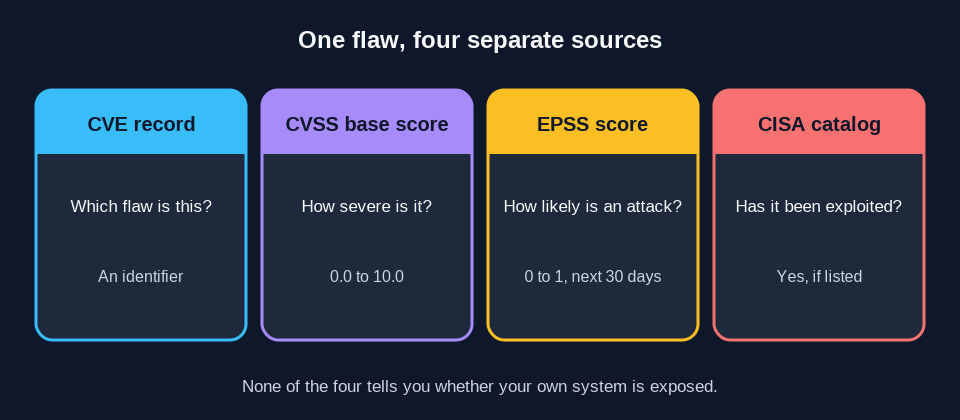
| Source | Question it answers | What it cannot tell you |
|---|---|---|
| CVE record | Which flaw is this? | How bad or how urgent it is |
| CVSS base score | How severe is the flaw in general? | Whether anyone is attacking it |
| EPSS score | How likely is exploitation in the next 30 days? | Whether it has happened |
| CISA exploited catalog | Has exploitation been confirmed? | Whether your system is exposed |
What CVSS scores look like for exploited vulnerabilities
CISA’s Known Exploited Vulnerabilities catalog names flaws that have been attacked in the wild. I used version 2026.10.27 with 1,760 entries. It is a good test set, because every flaw in it has been attacked in the real world.
For each entry I took one CVSS version 3 base score by a fixed rule: version 3.1 before 3.0, the CNA’s score first, then CISA’s, then any other provider.
Twelve entries carried more than one version 3 score. None of them conflicted. I found a version 3 score for 1,681 entries.
The other 79 had only a version 4.0 score.
Where the scores came from
| Source of the score | Entries |
|---|---|
| CISA’s enrichment container | 990 |
| The CNA that published the record | 689 |
| Another provider | 2 |
More than half of the scores came from CISA’s own enrichment, not from the party that published the CVE.
That shows that scores are often added after the fact by a third party, so a record can exist for a while before it has a score.
The distribution
| Rating | Entries | Share |
|---|---|---|
| Critical, 9.0 to 10.0 | 571 | 34.0% |
| High, 7.0 to 8.9 | 899 | 53.5% |
| Medium, 4.0 to 6.9 | 202 | 12.0% |
| Low, 0.1 to 3.9 | 9 | 0.5% |
The median score was 8.8, and the mean was 8.35. A large majority, 87.4 percent, were High or Critical. That fits the idea that attackers favor serious flaws.
It also means that 12.6 percent of exploited flaws were rated Medium or Low.
A few scores repeat
Individual scores cluster. In the catalog, 385 entries scored exactly 9.8, which is 22.9 percent of those with a version 3 score. A further 312 scored 7.8, 278 scored 8.8, 108 scored 7.5 and 85 scored 10.0.
The reason is that the scoring formula produces a limited set of values. I enumerated all 2,592 possible combinations of the version 3.1 base metrics and calculated each score. These are mathematical combinations, not 2,592 real vulnerabilities.
They produce only 84 distinct scores, counting 0.0.
What the possible vectors look like
| Rating | Share of all 2,592 possible vectors |
|---|---|
| Critical | 2.4% |
| High | 21.4% |
| Medium | 56.5% |
| Low | 16.0% |
| None | 3.7% |
Critical scores are rare in the space of possible vectors, at 2.4 percent, yet one third of exploited flaws score Critical. Real vulnerabilities do not spread evenly across the metric combinations.
Attackers favor the combinations that are easy and powerful: network access, no privileges, no interaction and high impact.
How exploited flaws are reached
I counted the metric values in the vectors of the exploited flaws.
| Metric | Value | Share of entries |
|---|---|---|
| Attack vector | Network | 72.5% |
| Attack vector | Local | 25.5% |
| Attack vector | Adjacent | 1.7% |
| Attack vector | Physical | 0.4% |
| Privileges required | None | 71.9% |
| Privileges required | Low | 23.2% |
| Privileges required | High | 4.9% |
| User interaction | None | 72.8% |
| User interaction | Required | 27.2% |
Nearly three quarters of exploited flaws could be attacked over a network, without privileges and without anyone clicking anything. Those traits make a flaw easy to use at scale, which explains why attackers favor them.
Local and user-interaction flaws still account for roughly a quarter each, so they cannot be ignored.
CVSS 4.0 adoption
Only 115 of the 1,760 entries, or 6.5 percent, had a CVSS 4.0 score, and 79 of those had no version 3 score at all.
Most of the exploited flaws in the catalog predate the new version, so scores are mostly version 3.
Thirty-six entries had both a version 3 score and a 4.0 score, which lets me compare them.
| Comparison of 36 entries | Result |
|---|---|
| Mean version 3 score | 8.49 |
| Mean version 4.0 score | 8.60 |
| Version 4.0 lower | 21 |
| Version 4.0 higher | 12 |
| Equal | 3 |
Thirty-six pairs is a small sample, and the two versions use different metrics and different scoring methods. The means are shown for description only and do not show that the versions agree. Individual scores moved in both directions.
The three largest changes were CVE-2025-21590, from 4.4 to 6.7, CVE-2026-110936, from 6.7 to 8.4, and CVE-2025-35939, from 5.3 to 6.9.
Treat scores from different versions as different measurements, and check which one a tool shows.
Severity is not the same as risk
A CVSS base score describes a flaw’s intrinsic characteristics. As the section on metric groups explains, the temporal, threat and environmental groups exist to add time and context, but published scores rarely include them.
A base score does not know whether anyone is attacking the flaw, or whether your system is exposed.
To see how severity and exploitation line up, I added exploit-prediction scores. EPSS, from FIRST, estimates the probability that a CVE will be exploited in the next 30 days. I pulled the scores for all 1,760 entries.
They carry the score date November 18, 2026 and the model version label v2026.06.15, as written in FIRST’s daily file.
Comparing exploited flaws with all scored CVEs
| Measure | Exploited flaws in the catalog | All CVEs with an EPSS score |
|---|---|---|
| Number scored | 1,760 | 408,395 |
| Median EPSS | 0.545 | 0.006 |
| EPSS of 0.1 or more | 76.1% | 4.3% |
| EPSS of 0.5 or more | 51.9% | 1.1% |
| EPSS below 0.01 | 2.7% | 63.5% |
Exploited flaws have much higher scores than the CVE population as a whole. That is a description of the data and not a test of EPSS, because I did not check how much EPSS’s training data overlaps with the catalog.
EPSS uses evidence of exploitation, so some circularity is likely.
This comparison is descriptive. It is not an independent test of how well EPSS predicts, and it does not validate EPSS’s accuracy.
EPSS by CVSS rating among exploited flaws
| CVSS rating | Entries | Median EPSS | Share with EPSS of 0.1 or more |
|---|---|---|---|
| Critical | 571 | 0.921 | 91.6% |
| High | 899 | 0.323 | 69.4% |
| Medium | 202 | 0.187 | 61.9% |
| Low | 9 | 0.136 | 55.6% |
EPSS rises with CVSS severity, which is reassuring. Even so, 61.9 percent of the exploited Medium-rated flaws had an EPSS of 0.1 or more.
A policy of fixing only High and Critical flaws would have left a significant group of exploited flaws for later.
Prioritizing with more than a score
Good triage blends several signals. For US federal agencies, CISA’s directive BOD 26-04 ranks urgency on four questions. Is the asset publicly exposed? Is the flaw in the exploited catalog? Can an attacker automate the exploit?
How much control does the attacker gain? It replaces two earlier directives and binds federal civilian executive branch agencies only. CISA’s announcement describes it.
Being in the catalog means CISA has evidence the flaw has been exploited somewhere. It does not mean every affected installation is exposed or compromised. Our zero-day vulnerability guide describes that directive and the catalog in more detail.
You can build a similar triage for your own systems. I invented a simple scoring model with these inputs.
| Signal | Question | Points |
|---|---|---|
| Exposure | Is the asset reachable from the internet? | 0 to 3 |
| Known exploitation | Is the flaw in the exploited catalog? | 0 to 3 |
| Exploit likelihood | Is the EPSS score high? | 0 to 2 |
| Impact | Would an attacker gain control or reach sensitive data? | 0 to 2 |
| CVSS rating | Medium counts 1, High 2, Critical 3 | 0 to 3 |
Assume four findings. The first is a Critical flaw on an isolated machine that is not in the catalog. The second is a High flaw on an internet-facing gateway that is in the catalog.
The third is a Medium flaw on an internet-facing server that is in the catalog with a high EPSS. The fourth is a High flaw on an internal server, not in the catalog, with low EPSS.
| Finding | Exposure | Known exploited | EPSS | Impact | CVSS | Total |
|---|---|---|---|---|---|---|
| Medium flaw on an exposed server, in the catalog | 3 | 3 | 2 | 1 | 1 | 10 |
| High flaw on an exposed gateway, in the catalog | 3 | 3 | 1 | 2 | 2 | 11 |
| High flaw on an internal server | 1 | 0 | 0 | 1 | 2 | 4 |
| Critical flaw on an isolated machine | 0 | 0 | 0 | 2 | 3 | 5 |
The exposed Medium flaw scores 10 and outranks the isolated Critical one at 5. A queue sorted only by CVSS would put the Critical flaw first.
This is an unvalidated teaching example, not a production risk model. The weights are my own and have not been tested against outcomes.
Three rules keep it safe to use. Score an unknown value as the worst case until you have checked it. Treat a flaw that is both exploited and on an exposed system as urgent whatever its total.
And never let a low total override a vendor’s emergency advisory.
What changes a score most
To see how the metrics move a score, I started from the common critical vector, which scores 9.8, and changed one metric at a time. These are my own calculations with the version 3.1 formula.
| Change to the 9.8 vector | New score | Rating | Change |
|---|---|---|---|
| Attack vector from Network to Adjacent | 8.8 | High | -1.0 |
| Attack vector to Local | 8.4 | High | -1.4 |
| Attack vector to Physical | 6.8 | Medium | -3.0 |
| Attack complexity from Low to High | 8.1 | High | -1.7 |
| Privileges required from None to Low | 8.8 | High | -1.0 |
| Privileges required to High | 7.2 | High | -2.6 |
| User interaction from None to Required | 8.8 | High | -1.0 |
| Scope from Unchanged to Changed | 10.0 | Critical | +0.2 |
| Confidentiality, integrity or availability from High to Low | 9.4 | Critical | -0.4 |
| Confidentiality or availability from High to None | 9.1 | Critical | -0.7 |
Physical access and high required privileges lower the score the most. Requiring a user to click lowers it by a full point. Reducing one impact metric from High to Low barely changes it, because the other two stay high.
Two combinations are worth knowing. A local attack needing low privileges, with high impact on all three, scores 7.8. A network attack that needs a user to click scores 8.8.
Both are High, and both are common in the exploited catalog.
Who does what: CVE, NVD and enrichment
The ecosystem has several players, and my download shows the pattern. This table is our summary of what I observed in the records.
| Party | Role |
|---|---|
| CVE Program | Maintains the identifier system and the record format |
| CNA | Assigns identifiers in its scope and publishes the initial record |
| Enrichment providers | Add scores, weakness types and other data after publication |
| Scoring sources | Vendors, CNAs and third parties may each publish scores |
| Scanners and tools | Match flaws in your systems to identifiers |
In my data, 990 of the chosen scores came from CISA’s enrichment container and 689 from the CNA. A record can be published first and enriched later, so a flaw without a score is not necessarily low risk.
Check again before ranking it.
CVE year and the age of exploitation
Another detail from the same catalog helps with reading CVE numbers. I compared the year in each identifier with the year the flaw was added to the exploited catalog.
| Gap between identifier year and catalog year | Share of entries |
|---|---|
| Same year | 44.8% |
| Three or more years later | 32.7% |
| Identifier from 2018 or earlier | 24.9% |
Nearly half of the flaws were listed in the year of their identifier, and a third entered the catalog three or more years later.
So a flaw can become a target long after it appears, and an old identifier does not mean a safe flaw. The same analysis appears in our zero-day vulnerability guide.
The limits of CVSS
CVSS is useful and widely used. It also has well-known limits, which my data illustrates.
| Limit | What it means in practice |
|---|---|
| It rates the flaw, not your risk | The same flaw is more dangerous on an exposed system |
| Scores cluster | Only 84 distinct base scores exist, so many flaws tie |
| Scorers can differ | Different organizations may rate the same flaw differently |
| Temporal fields are used inconsistently | Eighteen published scores matched the temporal formula, not the base one |
| Versions differ | A score from one version is not directly comparable to another |
| It does not say who is attacking | Exploitation data comes from other sources |
Reading a CVE record
When you open a CVE record, look at these parts in order.
- Description: Does it describe your product and version?
- Affected versions: Are you in the range?
- References: Is there a vendor advisory with a fix or workaround?
- Weakness type: The CWE entry tells you the class of bug.
- CVSS vector: Read the metrics, not only the number.
- Source of the score: Check whether it came from the vendor, the CNA or another party.
- Exploitation status: Check the exploited catalog and an exploit-likelihood score.
Four places let you check a record yourself: the record at cve.org, the analysis at NVD, CISA’s Known Exploited Vulnerabilities catalog and the vendor’s own advisory, which the record links under references.
The vector is more informative than the number. Two flaws that both score 7.5 may differ in the attack path, the privileges needed or the kind of impact. The vector tells you which applies to you.
A practical workflow
- Inventory your software and versions.
- Match each finding to its CVE record.
- Check whether the CVE is in the exploited catalog.
- Look up its EPSS score.
- Check whether the affected asset is exposed.
- Use CVSS to size the impact, then rank the findings.
- Confirm in the vendor’s advisory that your exact product version is affected before you patch.
- Apply the fix. If no fix exists yet, apply the vendor’s temporary mitigation and note it.
- Record exceptions with a review date.
To trace which components bring each CVE into your software, see our software supply chain security guide. If a flaw has already been used against you, our incident response plan guide gives the steps.
A penetration test checks whether the flaws on your list can actually be reached and used in your environment, which no score can tell you.
Common mistakes
- Treating CVSS as risk: A base score ignores your environment.
- Ignoring Medium flaws: In my data, 202 of 1,681 scored exploited flaws were Medium.
- Comparing scores across versions: Check which version a number uses.
- Trusting a single number: Read the vector.
- Waiting for a score: Many records get scores later, often from a third party.
- Fixing by age alone: Old flaws can be exploited, and new ones can be too.
- Forgetting exposure: The same flaw matters more on an internet-facing system.
- Skipping exploitation data: Use the exploited catalog and an exploit-likelihood score.
Myths about CVE and CVSS
| Myth | What is more accurate |
|---|---|
| A CVE is a vulnerability scanner result | A CVE is an identifier, and scanners use it to refer to flaws |
| CVSS measures how likely an attack is | It rates characteristics, and likelihood comes from other sources |
| A 10.0 is always the worst problem for you | Exposure and exploitation can outweigh score |
| A Low score means ignore it | Nine exploited flaws in my data were rated Low |
| The CVE year is the year of discovery | It reflects when the identifier was assigned or reserved |
A 30-day plan
This plan is our suggestion.
- Days 1 to 7: Build an inventory of systems and software versions.
- Days 8 to 14: Map findings to CVE records, and note the source and version of each score.
- Days 15 to 21: Add exploited-catalog and exploit-likelihood checks to your triage.
- Days 22 to 26: Rank findings with a score that includes exposure.
- Days 27 to 30: Write a patching policy with fix times by rank, and review the exceptions.
A CVSS 3.1 calculator you can run
The published script doubles as a calculator. Give it a version 3.1 vector and it prints the base score, and the temporal score if the vector includes temporal metrics.
python3 cvss_analysis.py --score "CVSS:3.1/AV:N/AC:L/PR:N/UI:N/S:U/C:H/I:H/A:H"That prints a base score of 9.8, Critical. The calculator rejects a malformed vector and tells you which part is wrong.
It does not score versions 2.0, 3.0 or 4.0. It accepts environmental metrics in a vector but does not compute an environmental score.
CVSS calculators and vulnerability-prioritization tools
Each tool below answers a different question. None of them replaces the others.
| Tool | What it does | What it does not do | Use it when |
|---|---|---|---|
| FIRST CVSS 3.1 calculator | Sets base, temporal and environmental metrics and returns the vector and scores | It does not look up a CVE for you | You have a vector to check, or want an environmental score for your own setup |
| FIRST CVSS 4.0 calculator | Scores version 4.0 metric groups | It cannot convert a 3.1 score | A vendor publishes a 4.0 vector |
| NVD | Publishes its own analysis of CVE records, with scores | It is not the source of the CVE record itself | You want a second opinion on a score |
| EPSS | Estimates the chance of exploitation in the next 30 days | It does not measure severity or confirm an attack | You are ranking many findings and need a likelihood signal |
| CISA exploited catalog | Lists flaws with confirmed exploitation | It is not a complete list of exploited flaws | You need the short list to fix first |
| The script in this guide | Scores a 3.1 base or temporal vector offline and reruns the analysis | No environmental score, no 4.0 | You want to verify a published score yourself |
A limit on this table: NVD’s page did not load fully for me, so its row describes NVD’s role in general terms. The FIRST 4.0 calculator is linked from the 4.0 specification.
A sensible order for a small team is to read the record, check the exploited catalog, look at EPSS, then use CVSS to judge impact. Commercial scanners combine these sources, and I have not tested any of them.
Reproduce the numbers
The script and its inputs are published with this guide.
- The script and the output of my run.
- The catalog snapshot, version 2026.10.27.
- The CVSS metrics extracted from each CVE record on November 19, 2026.
- The EPSS scores for the catalog entries, dated November 18, 2026.
- FIRST’s full daily EPSS file for November 18, 2026, with 408,395 scored CVEs.
Put the five files in one folder and run the analysis. You need Python 3.9 or later and nothing else.
python3 cvss_analysis.pyWith all four data files present the run is frozen. It needs no network access and took under a minute on my machine.
A frozen run must reproduce the published figures. The script checks more than 20 of them at the end and stops with an error if any required step fails. It also checks each data file against its published SHA-256 hash before the analysis starts, and stops on a mismatch.
| File | SHA-256, first 16 characters |
|---|---|
| cisa-kev-2026.10.27.json | 1b932c01923ad070 |
| cve-metrics.json | 5705df6f84f061af |
| epss-snapshot.json | 0f4142517509cd41 |
| epss_scores-2026-11-18.csv.gz | 3b77048ef8d0b3ce |
A live refresh is different. Delete the metrics file, the EPSS file or the full EPSS file and the script fetches live data in its place. The catalog snapshot cannot be rebuilt, so keep it.
Live records and scores change daily. A refreshed run labels its output as live, skips the frozen-figure checks and does not print the final pass message.
The script validates every vector before scoring it and stops on a malformed one. It retries failed downloads and never stores a failure as an empty record.
It validates the full EPSS file too: columns, row lengths, unique identifiers and scores between 0 and 1. It reports entries that carry more than one score and applies one fixed rule for choosing between them.
"""CVSS 3.1 calculator and analysis of CISA's Known Exploited Vulnerabilities catalog.
Python 3.9+, standard library only.

Calculator:  python3 cvss_analysis.py --score "CVSS:3.1/AV:N/AC:L/PR:N/UI:N/S:U/C:H/I:H/A:H"
Analysis:    python3 cvss_analysis.py

Inputs, kept beside this file so the analysis can be repeated exactly:
  cisa-kev-2026.10.27.json   catalog snapshot. Required. The script cannot rebuild it.
  cve-metrics.json           CVSS metrics from each CVE record. Rebuilt from the live CVE List if deleted.
  epss-snapshot.json         EPSS scores for the catalog entries. Rebuilt from the live API if deleted.
  epss_scores-2026-11-18.csv.gz   FIRST's full daily EPSS file for that date. Used in frozen runs only.
With all four files present the run is frozen and must reproduce the published figures.
A rebuilt file holds live data, which changes daily, so the frozen-figure checks are skipped."""
import collections
import concurrent.futures
import csv
import datetime
import gzip
import hashlib
import io
import itertools
import json
import math
import pathlib
import statistics
import sys
import time
import urllib.parse
import urllib.request

HERE = pathlib.Path(__file__).resolve().parent
KEV_FILE = HERE / "cisa-kev-2026.10.27.json"
METRICS_FILE = HERE / "cve-metrics.json"
EPSS_FILE = HERE / "epss-snapshot.json"
EPSS_ALL_FILE = HERE / "epss_scores-2026-11-18.csv.gz"
CVE_URL = "https://raw.githubusercontent.com/CVEProject/cvelistV5/main/cves/{year}/{bucket}xxx/{cve}.json"
EPSS_URL = "https://api.first.org/data/v1/epss"
EPSS_ALL_URL = "https://epss.empiricalsecurity.com/epss_scores-current.csv.gz"

# ---- CVSS 3.1 base and temporal formulas, from the FIRST specification ----
AV = {"N": 0.85, "A": 0.62, "L": 0.55, "P": 0.2}
AC = {"L": 0.77, "H": 0.44}
UI = {"N": 0.85, "R": 0.62}
CIA = {"H": 0.56, "L": 0.22, "N": 0.0}
PR_UNCHANGED = {"N": 0.85, "L": 0.62, "H": 0.27}
PR_CHANGED = {"N": 0.85, "L": 0.68, "H": 0.5}
E = {"X": 1, "H": 1, "F": 0.97, "P": 0.94, "U": 0.91}
RL = {"X": 1, "U": 1, "W": 0.97, "T": 0.96, "O": 0.95}
RC = {"X": 1, "C": 1, "R": 0.96, "U": 0.92}


def roundup(value):
    """Round up to one decimal, as defined in Appendix A of the 3.1 specification."""
    integer = int(round(value * 100000))
    return integer / 100000.0 if integer % 10000 == 0 else (math.floor(integer / 10000) + 1) / 10.0


def parse(vector):
    return dict(part.split(":") for part in vector.split("/")[1:])


def base_score(vector):
    m = parse(vector)
    changed = m["S"] == "C"
    iss = 1 - (1 - CIA[m["C"]]) * (1 - CIA[m["I"]]) * (1 - CIA[m["A"]])
    impact = 7.52 * (iss - 0.029) - 3.25 * (iss - 0.02) ** 15 if changed else 6.42 * iss
    privileges = (PR_CHANGED if changed else PR_UNCHANGED)[m["PR"]]
    exploitability = 8.22 * AV[m["AV"]] * AC[m["AC"]] * privileges * UI[m["UI"]]
    if impact <= 0:
        return 0.0
    total = impact + exploitability
    return roundup(min(1.08 * total if changed else total, 10))


def temporal_score(vector):
    m = parse(vector)
    return roundup(base_score(vector) * E[m.get("E", "X")] * RL[m.get("RL", "X")] * RC[m.get("RC", "X")])


VALID = {"AV": AV, "AC": AC, "PR": PR_UNCHANGED, "UI": UI, "S": {"U": 0, "C": 0}, "C": CIA, "I": CIA, "A": CIA}
OPTIONAL = {"E": E, "RL": RL, "RC": RC}
# Environmental metrics are valid in a 3.1 vector. This script recognizes them but does not score them.
ENVIRONMENTAL = {"CR": "XHML", "IR": "XHML", "AR": "XHML", "MAV": "XNALP", "MAC": "XLH", "MPR": "XNLH",
                 "MUI": "XNR", "MS": "XUC", "MC": "XHLN", "MI": "XHLN", "MA": "XHLN"}


def validate(vector):
    """Return an error message, or None when the 3.1 vector is well formed."""
    parts = vector.strip().split("/")
    if parts[0] != "CVSS:3.1":
        return "the vector must start with CVSS:3.1 (this calculator does not score 2.0, 3.0 or 4.0)"
    seen = {}
    for part in parts[1:]:
        if part.count(":") != 1:
            return f"cannot read '{part}'"
        name, value = part.split(":")
        allowed = VALID.get(name) or OPTIONAL.get(name) or ENVIRONMENTAL.get(name)
        if allowed is None:
            return f"unknown metric '{name}'"
        if value not in allowed:
            return f"'{value}' is not a valid value for {name}"
        if name in seen:
            return f"metric {name} appears twice"
        seen[name] = value
    missing = [name for name in VALID if name not in seen]
    return f"missing base metrics: {', '.join(missing)}" if missing else None


def severity(score):
    return "None" if score == 0 else "Low" if score < 4 else "Medium" if score < 7 else "High" if score < 9 else "Critical"


def percent(part, whole):
    return f"{part / whole:.1%}"


def get(url, timeout=60):
    request = urllib.request.Request(url, headers={"User-Agent": "cvss-analysis-script"})
    with urllib.request.urlopen(request, timeout=timeout) as reply:
        return reply.read()


if len(sys.argv) > 1:
    if len(sys.argv) != 3 or sys.argv[1] != "--score":
        raise SystemExit('usage: python3 cvss_analysis.py --score "CVSS:3.1/AV:N/AC:L/PR:N/UI:N/S:U/C:H/I:H/A:H"')
    problem = validate(sys.argv[2])
    if problem:
        raise SystemExit("Invalid vector: " + problem)
    base = base_score(sys.argv[2])
    print(f"Base score: {base} ({severity(base)})")
    if any(name in parse(sys.argv[2]) for name in OPTIONAL):
        temporal = temporal_score(sys.argv[2])
        print(f"Temporal score: {temporal} ({severity(temporal)})")
    if any(name in parse(sys.argv[2]) for name in ENVIRONMENTAL):
        print("Environmental metrics are present. This calculator does not compute an environmental score.")
    raise SystemExit(0)

# ---- 1. Formula checks against the worked examples in the specification ----
assert base_score("CVSS:3.1/AV:N/AC:L/PR:N/UI:N/S:U/C:H/I:H/A:H") == 9.8
assert base_score("CVSS:3.1/AV:N/AC:L/PR:N/UI:N/S:C/C:H/I:H/A:H") == 10.0
assert base_score("CVSS:3.1/AV:N/AC:L/PR:N/UI:N/S:U/C:N/I:N/A:N") == 0.0
assert validate("CVSS:3.1/AV:N/AC:L/PR:N/UI:N/S:U/C:H/I:H/A:H") is None
assert validate("CVSS:3.1/AV:N/AC:L/PR:N/UI:N/S:U/C:H/I:H") is not None
assert validate("CVSS:4.0/AV:N") is not None
assert validate("CVSS:3.1/AV:N/AC:L/PR:N/UI:N/S:U/C:H/I:H/A:H/CR:H/MAV:N") is None
assert validate("CVSS:3.1/AV:N/AC:L/PR:N/UI:N/S:U/C:H/I:H/A:H/ZZ:1") is not None
print("1. formula and validation checks passed: 9.8, 10.0 and 0.0")

# ---- 2. Every possible CVSS 3.1 base vector ----
possible = [base_score(f"CVSS:3.1/AV:{av}/AC:{ac}/PR:{pr}/UI:{ui}/S:{s}/C:{c}/I:{i}/A:{a}")
            for av, ac, pr, ui, s, c, i, a in itertools.product("NALP", "LH", "NLH", "NR", "UC", "HLN", "HLN", "HLN")]
bands = collections.Counter(severity(x) for x in possible)
print("2. possible vectors:", len(possible), "| distinct scores:", len(set(possible)),
      "|", {name: percent(bands[name], len(possible)) for name in ("Critical", "High", "Medium", "Low", "None")})

# ---- 3. Catalog snapshot and CVE records ----
if not KEV_FILE.exists():
    raise SystemExit(f"Missing {KEV_FILE.name}. The catalog snapshot must be downloaded with the article.")
FROZEN = METRICS_FILE.exists() and EPSS_FILE.exists() and EPSS_ALL_FILE.exists()
print("   mode:", "frozen reproduction from published data files" if FROZEN else "live refresh, figures will differ")
EXPECTED_HASHES = {
    "cisa-kev-2026.10.27.json": "1b932c01923ad07012c4f5bddf1fa22f9f043d6eaeeb4866a234e175d6fbddc7",
    "cve-metrics.json": "5705df6f84f061afdbb07aadd9241ededd74e55fa9ae15f6e3ec464f922ce5b1",
    "epss-snapshot.json": "0f4142517509cd415099688c58ea504cd6753f1c3f2c02f382396c32ca3baa2b",
    "epss_scores-2026-11-18.csv.gz": "3b77048ef8d0b3cec3d7a941bf8d0e39212f40e48071307f61074a6a69fa7b3d",
}
for path in (KEV_FILE, METRICS_FILE, EPSS_FILE, EPSS_ALL_FILE):
    if path.exists():
        actual = hashlib.sha256(path.read_bytes()).hexdigest()
        print(f"   sha256 {actual}  {path.name}")
        if FROZEN and actual != EXPECTED_HASHES[path.name]:
            raise SystemExit(f"SHA-256 mismatch for {path.name}: expected {EXPECTED_HASHES[path.name]}, got {actual}. "
                             "This is not the published file, so the run is not a reproduction.")
catalog = json.loads(KEV_FILE.read_text())
entries = catalog["vulnerabilities"]
ids = sorted({entry["cveID"] for entry in entries})
print("3. catalog version", catalog["catalogVersion"], "| entries", len(entries), "| unique CVE IDs", len(ids))
assert len(ids) == len(entries), "duplicate CVE IDs in the catalog"


def fetch_metrics(cve):
    year, number = cve.split("-")[1:]
    record, problem = None, None
    for attempt in range(4):                # retry temporary failures
        try:
            record = json.loads(get(CVE_URL.format(year=year, bucket=int(number) // 1000, cve=cve), 30))
            break
        except Exception as error:
            problem = error
            time.sleep(2 * (attempt + 1))
    if record is None:
        return cve, {"error": str(problem)}
    found = []
    containers = [("cna", record["containers"]["cna"])] + [
        ((adp.get("providerMetadata") or {}).get("shortName") or "adp", adp) for adp in record["containers"].get("adp", [])]
    for source, container in containers:
        for metric in container.get("metrics", []):
            for key in ("cvssV4_0", "cvssV3_1", "cvssV3_0", "cvssV2_0"):
                if key in metric:
                    found.append({"version": key, "source": source,
                                  "score": metric[key].get("baseScore"), "vector": metric[key].get("vectorString")})
    return cve, {"metrics": found}


if METRICS_FILE.exists():
    cache = json.loads(METRICS_FILE.read_text())
else:
    with concurrent.futures.ThreadPoolExecutor(16) as pool:
        records = dict(pool.map(fetch_metrics, ids))
    unresolved = sorted(cve for cve, r in records.items() if "error" in r)
    if unresolved:                          # never cache a failure as if it were a record without metrics
        raise SystemExit(f"{len(unresolved)} CVE records could not be read after retries: {unresolved[:10]}")
    cache = {"fetched": datetime.date.today().isoformat(), "records": records}
    METRICS_FILE.write_text(json.dumps(cache, indent=0, sort_keys=True))
records = cache["records"]
assert set(records) == set(ids), "the metrics file does not cover exactly the catalog's CVE IDs"
assert not any("error" in r for r in records.values()), "the metrics file contains failed records"
print("   CVE records read on", cache["fetched"], "| records", len(records), "| failed 0")


def metrics(cve, version=None):
    rows = records.get(cve, {}).get("metrics", [])
    return [r for r in rows if version is None or r["version"] == version]


# ---- 4. Calculator against every published 3.1 vector ----
candidates = [(cve, r) for cve in ids for r in metrics(cve, "cvssV3_1")]
not_scorable = [(cve, r) for cve, r in candidates
                if not r["vector"] or not r["vector"].startswith("CVSS:3.1") or r["score"] is None]
pairs = [pair for pair in candidates if pair not in not_scorable]
invalid = [(cve, r["vector"], validate(r["vector"])) for cve, r in pairs if validate(r["vector"])]
print("4. cvssV3_1 metric entries:", len(candidates), "| without a 3.1 vector or a score:", len(not_scorable),
      "| malformed 3.1 vectors:", len(invalid))
for cve, r in not_scorable:
    print(f"     excluded {cve} | source {r['source']} | score {r['score']} | vector {r['vector']}")
if invalid:
    raise SystemExit("Malformed CVSS 3.1 vectors in CVE records: " + "; ".join(f"{c} {v} ({why})" for c, v, why in invalid[:10]))
has_temporal = lambda vector: any(f"/{name}:" in vector for name in ("E", "RL", "RC"))
match_base = [p for p in pairs if abs(base_score(p[1]["vector"]) - p[1]["score"]) < 1e-9]
mismatch = [p for p in pairs if p not in match_base]
with_t = [p for p in pairs if has_temporal(p[1]["vector"])]
without_t = [p for p in pairs if not has_temporal(p[1]["vector"])]
t_base = [p for p in with_t if p in match_base]
t_temporal = [p for p in with_t if p not in match_base and abs(temporal_score(p[1]["vector"]) - p[1]["score"]) < 1e-9]
unexplained = [p for p in mismatch if p not in t_temporal]
print("   3.1 vector and score pairs:", len(pairs), "| match base formula:", len(match_base),
      "| differ:", len(mismatch), "| match rate:", percent(len(match_base), len(pairs)))
print("   with temporal metrics:", len(with_t), "| equal base:", len(t_base), "| equal temporal only:", len(t_temporal),
      "| neither:", len(with_t) - len(t_base) - len(t_temporal))
print("   without temporal metrics:", len(without_t), "| equal base:", sum(p in match_base for p in without_t),
      "| differ:", sum(p not in match_base for p in without_t))
print("   unexplained mismatches:")
for cve, r in unexplained:
    print(f"     {cve} | source {r['source']} | published {r['score']} | formula {base_score(r['vector'])} | {r['vector']}")


# ---- 5. One version 3 score per catalog entry ----
# Selection policy, applied in this order and never by position in the record:
#   version 3.1 before 3.0; within a version the CNA's score, then CISA-ADP, then other providers by name;
#   within one provider the highest score, then the vector text, so the choice is deterministic.
def provider_rank(source):
    return (0, "") if source == "cna" else (1, "") if source == "CISA-ADP" else (2, source)


def choose(cve, versions=("cvssV3_1", "cvssV3_0")):
    for version in versions:
        rows = [r for r in metrics(cve, version) if r["score"] is not None]
        if rows:
            return min(rows, key=lambda r: (provider_rank(r["source"]), -r["score"], r["vector"] or ""))
    return None


v3_conflicts = [cve for cve in ids
                if len({r["score"] for r in metrics(cve) if r["version"] in ("cvssV3_1", "cvssV3_0") and r["score"] is not None}) > 1]
v3_multiple = [cve for cve in ids
               if len([r for r in metrics(cve) if r["version"] in ("cvssV3_1", "cvssV3_0") and r["score"] is not None]) > 1]


chosen = {cve: choose(cve) for cve in ids}
chosen = {cve: r for cve, r in chosen.items() if r}
values = [r["score"] for r in chosen.values()]
no_v3 = [cve for cve in ids if cve not in chosen]
only_v4 = [cve for cve in no_v3 if metrics(cve, "cvssV4_0")]
print("5. entries with more than one version 3 score:", len(v3_multiple), "| with conflicting version 3 scores:", len(v3_conflicts))
print("   entries with a version 3 score:", len(values), "| without:", len(no_v3), "| of those, with a 4.0 score:", len(only_v4),
      "| with no CVSS score at all:", sum(1 for cve in no_v3 if not metrics(cve)))
print("   score source:", dict(collections.Counter("CNA" if r["source"] == "cna" else r["source"] for r in chosen.values()).most_common()))
print("   score version:", dict(collections.Counter(r["version"] for r in chosen.values())))
band = collections.Counter(severity(v) for v in values)
print("   distribution:", {name: (band[name], percent(band[name], len(values))) for name in ("Critical", "High", "Medium", "Low")})
print("   median:", statistics.median(values), "| mean:", round(statistics.mean(values), 2),
      "| High or Critical:", percent(band["High"] + band["Critical"], len(values)))
print("   most common scores:", collections.Counter(values).most_common(4))
vectors = [r["vector"] for r in chosen.values() if r["vector"]]
for name in ("AV", "AC", "PR", "UI", "S"):
    counts = collections.Counter(parse(v)[name] for v in vectors)
    print(f"   {name}:", {k: percent(n, len(vectors)) for k, n in counts.most_common()})

# ---- 6. CVSS 4.0 ----
v4 = [cve for cve in ids if metrics(cve, "cvssV4_0")]
chosen_v4 = {cve: choose(cve, ("cvssV4_0",)) for cve in v4}
v4_conflicts = [cve for cve in v4 if len({r["score"] for r in metrics(cve, "cvssV4_0")}) > 1]
print("   4.0 score source:", dict(collections.Counter("CNA" if r["source"] == "cna" else r["source"] for r in chosen_v4.values())),
      "| entries with conflicting 4.0 scores:", len(v4_conflicts))
both = [(chosen[cve]["score"], chosen_v4[cve]["score"]) for cve in v4 if cve in chosen]
print("6. entries with a 4.0 score:", len(v4), percent(len(v4), len(ids)), "| scored under both:", len(both))
if both:
    print("   mean v3:", round(statistics.mean(a for a, b in both), 2), "| mean v4:", round(statistics.mean(b for a, b in both), 2),
          "| v4 lower:", sum(b < a for a, b in both), "| v4 higher:", sum(b > a for a, b in both), "| equal:", sum(a == b for a, b in both))

largest = sorted(((cve, chosen[cve]["score"], chosen_v4[cve]["score"]) for cve in v4 if cve in chosen),
                 key=lambda row: -abs(row[2] - row[1]))[:3]
print("   largest differences (CVE, v3, v4):", largest)
print("   entries scoring exactly 10.0:", sum(v == 10.0 for v in values))

# ---- 7. EPSS for the catalog entries ----
if EPSS_FILE.exists():
    epss_cache = json.loads(EPSS_FILE.read_text())
else:
    scores, dates = {}, set()
    for start in range(0, len(ids), 100):
        query = urllib.parse.urlencode({"cve": ",".join(ids[start:start + 100])})
        reply = json.loads(get(EPSS_URL + "?" + query))
        for row in reply["data"]:
            if row["cve"] in scores:
                raise SystemExit("EPSS API returned a CVE twice: " + row["cve"])
            scores[row["cve"]] = float(row["epss"])
            dates.add(row.get("date"))
    if len(dates) != 1:
        raise SystemExit(f"EPSS scores carry more than one date: {sorted(dates)}")
    epss_cache = {"score_date": dates.pop(), "scores": scores}
    EPSS_FILE.write_text(json.dumps(epss_cache, indent=0, sort_keys=True))
epss = epss_cache["scores"]
missing_epss = sorted(set(ids) - set(epss))
extra_epss = sorted(set(epss) - set(ids))
assert not extra_epss, "EPSS file holds CVE IDs that are not in the catalog"
assert all(0.0 <= value <= 1.0 for value in epss.values()), "EPSS score outside 0 to 1"
print("   catalog entries without an EPSS score:", len(missing_epss), missing_epss[:5])
kev_epss = list(epss.values())
print("7. EPSS score date:", epss_cache["score_date"], "| catalog entries with EPSS:", len(kev_epss),
      "| median:", round(statistics.median(kev_epss), 4),
      "| at least 0.1:", percent(sum(v >= 0.1 for v in kev_epss), len(kev_epss)),
      "| at least 0.5:", percent(sum(v >= 0.5 for v in kev_epss), len(kev_epss)),
      "| below 0.01:", percent(sum(v < 0.01 for v in kev_epss), len(kev_epss)))
by_band = collections.defaultdict(list)
for cve, r in chosen.items():
    if cve in epss:
        by_band[severity(r["score"])].append(epss[cve])
for name in ("Critical", "High", "Medium", "Low"):
    row = by_band[name]
    print(f"   {name}: {len(row)} entries | median EPSS {statistics.median(row):.4f} | at least 0.1: {percent(sum(v >= 0.1 for v in row), len(row))}")

# ---- 8. EPSS for every scored CVE ----
def read_full_epss(raw):
    """Parse and validate FIRST's daily file. Raises ValueError on any structural problem."""
    text = gzip.decompress(raw).decode()
    comment = next((line.strip("#") for line in text.splitlines() if line.startswith("#")), "")
    table = list(csv.reader(io.StringIO("\n".join(line for line in text.splitlines() if not line.startswith("#")))))
    if not table or table[0][:2] != ["cve", "epss"]:
        raise ValueError(f"unexpected columns: {table[0] if table else None}")
    rows = table[1:]
    if not rows:
        raise ValueError("no data rows")
    if any(len(row) != len(table[0]) for row in rows):
        raise ValueError("a row has the wrong number of fields")
    names = [row[0] for row in rows]
    if len(set(names)) != len(names):
        raise ValueError("a CVE identifier appears more than once")
    scores = [float(row[1]) for row in rows]
    if not all(0.0 <= value <= 1.0 for value in scores):
        raise ValueError("a score is outside 0 to 1")
    return comment, table[0], scores


full_epss_done = False
try:
    raw = EPSS_ALL_FILE.read_bytes() if FROZEN else get(EPSS_ALL_URL, 180)
    comment, columns, all_scores = read_full_epss(raw)
    full_epss_done = True
    print("8. full EPSS file:", "published dated file" if FROZEN else "LIVE download, not the published snapshot",
          "| comment:", comment, "| columns:", columns)
    print("   validated rows:", len(all_scores),
          "| median:", round(statistics.median(all_scores), 5),
          "| at least 0.1:", f"{sum(v >= 0.1 for v in all_scores) / len(all_scores):.2%}",
          "| at least 0.5:", f"{sum(v >= 0.5 for v in all_scores) / len(all_scores):.2%}",
          "| below 0.01:", percent(sum(v < 0.01 for v in all_scores), len(all_scores)))
except Exception as problem:
    if FROZEN:
        raise SystemExit(f"The published full EPSS file could not be read or validated: {problem}")
    print("8. full EPSS comparison UNAVAILABLE in this live run:", problem)

# ---- 9. One metric at a time, from the 9.8 vector ----
start_vector = dict(AV="N", AC="L", PR="N", UI="N", S="U", C="H", I="H", A="H")
print("9. change one metric from the 9.8 vector:")
for name, value in (("AV", "A"), ("AV", "L"), ("AV", "P"), ("AC", "H"), ("PR", "L"), ("PR", "H"), ("UI", "R"),
                    ("S", "C"), ("C", "L"), ("C", "N"), ("A", "L"), ("A", "N")):
    changed = dict(start_vector, **{name: value})
    vector = "CVSS:3.1/" + "/".join(f"{k}:{changed[k]}" for k in ("AV", "AC", "PR", "UI", "S", "C", "I", "A"))
    print(f"   {name}:{value} -> {base_score(vector)} {severity(base_score(vector))}")

# ---- 10. Identifier year against the year the entry was added ----
years = [(int(entry["dateAdded"][:4]), int(entry["cveID"].split("-")[1])) for entry in entries]
gaps = [added - issued for added, issued in years]
old = sum(1 for added, issued in years if issued <= 2018)
print("10. added in the identifier year:", percent(sum(g == 0 for g in gaps), len(gaps)),
      "| three or more years later:", percent(sum(g >= 3 for g in gaps), len(gaps)),
      "| identifier year 2018 or earlier:", old, percent(old, len(gaps)))

# ---- Checks ----
assert len(possible) == 2592 and len(set(possible)) == 84
assert catalog["catalogVersion"] == "2026.10.27" and len(entries) == 1760
assert len(match_base) + len(mismatch) == len(pairs)
assert sum(band.values()) == len(values)
if FROZEN:
    # Headline figures published in the article. They must hold for the published data files.
    assert cache["fetched"] == "2026-11-19" and epss_cache["score_date"].startswith("2026-11-18")
    assert (len(pairs), len(match_base), len(mismatch)) == (1626, 1604, 22)
    assert (len(with_t), len(t_base), len(t_temporal)) == (229, 210, 18)
    assert len(without_t) == 1397 and len(unexplained) == 4
    assert len(values) == 1681 and len(no_v3) == 79 and len(only_v4) == 79
    assert (band["Critical"], band["High"], band["Medium"], band["Low"]) == (571, 899, 202, 9)
    assert statistics.median(values) == 8.8 and round(statistics.mean(values), 2) == 8.35
    assert collections.Counter(values).most_common(3) == [(9.8, 385), (7.8, 312), (8.8, 278)]
    assert len(v4) == 115 and len(both) == 36
    assert len(kev_epss) == 1760 and not missing_epss
    assert sum(1 for added, issued in years if issued <= 2018) == 439
    assert full_epss_done and len(all_scores) == 408395 and "score_date:2026-11-18" in comment
    print("\nFrozen-figure checks passed")
    print("Checks passed")
else:
    print("\nLive refresh: frozen-figure checks skipped")
    print("Run finished" + ("" if full_epss_done else " WITHOUT the full EPSS comparison"))
Frequently asked questions
What is the difference between CVE and CVSS?
A CVE is an identifier for a specific flaw. CVSS is a system that scores how severe a flaw is on a scale from 0 to 10.
What is CVSS?
The Common Vulnerability Scoring System, maintained by FIRST. It calculates a score from metrics such as attack vector, complexity, privileges required and impact.
What is a CVSS score?
A number from 0.0 to 10.0 that rates a flaw’s severity. The usual bands are Low, Medium, High and Critical, with Critical starting at 9.0.
How is CVSS calculated?
For version 3.1, the base score combines an impact sub-score and an exploitability sub-score, each built from fixed metric weights, and rounds up to one decimal place.
What is a CVSS vector string?
A compact text description of the metrics used to produce a score. Anyone can recompute the score from the vector.
What is CVSS 4.0, or CVSS v4?
The newest version. It adds a metric called Attack Requirements and organizes metrics into Base, Threat, Environmental and Supplemental groups, with nomenclature such as CVSS-B and CVSS-BT.
Is a 9.8 CVSS score the worst?
No. A 10.0 is higher, and exposure, exploitation and impact in your environment matter as much as the score.
Is CVSS the same as risk?
No. It describes a flaw’s characteristics. Risk also depends on exposure, whether the flaw is attacked and what is at stake.
What is EPSS?
The Exploit Prediction Scoring System from FIRST, which estimates the probability of exploitation in the next 30 days.
Which CVSS version should I use?
Use the version your tools provide, label scores with the version, and avoid comparing numbers across versions.
How many exploited vulnerabilities are rated Medium?
In the catalog I analyzed, 202 of the 1,681 entries with a version 3 score, which is 12.0 percent. Against all 1,760 entries it is 11.5 percent.
A quick checklist
- Read the vector and not only the score.
- Check the version and source of every score.
- Check whether the flaw is in the exploited catalog.
- Look at the exploit-likelihood score.
- Rank by exposure and impact, not by CVSS alone.
Conclusion
Scores tell you how severe a flaw is, and exposure tells you how soon to act.
Read our zero-day vulnerability guide for patch-speed and priority models, and our incident response plan guide for what to do when a flaw is used against you.
From circuittimes.com/security/cve-vs-cvss/
Was this guide helpful?
What went wrong?
Read nextExplainer 45 min readBug Bounty Programs Explained: Pay, Platforms and Real DataBug bounty explained with real data: what programs pay, how platforms work, what hunters earn, and a survey of 1,000 sites.
Explainer 39 min readPenetration Testing Explained: Types and Process
Explainer 26 min readCloud Security Fundamentals: Controls, Tests and Checklist
Explainer 22 min readZero-Day Vulnerability: Meaning, Lifecycle and Real Data
The briefing, without the noise.
The stories that matter in technology, every weekday morning.
Free. Unsubscribe in one click.